
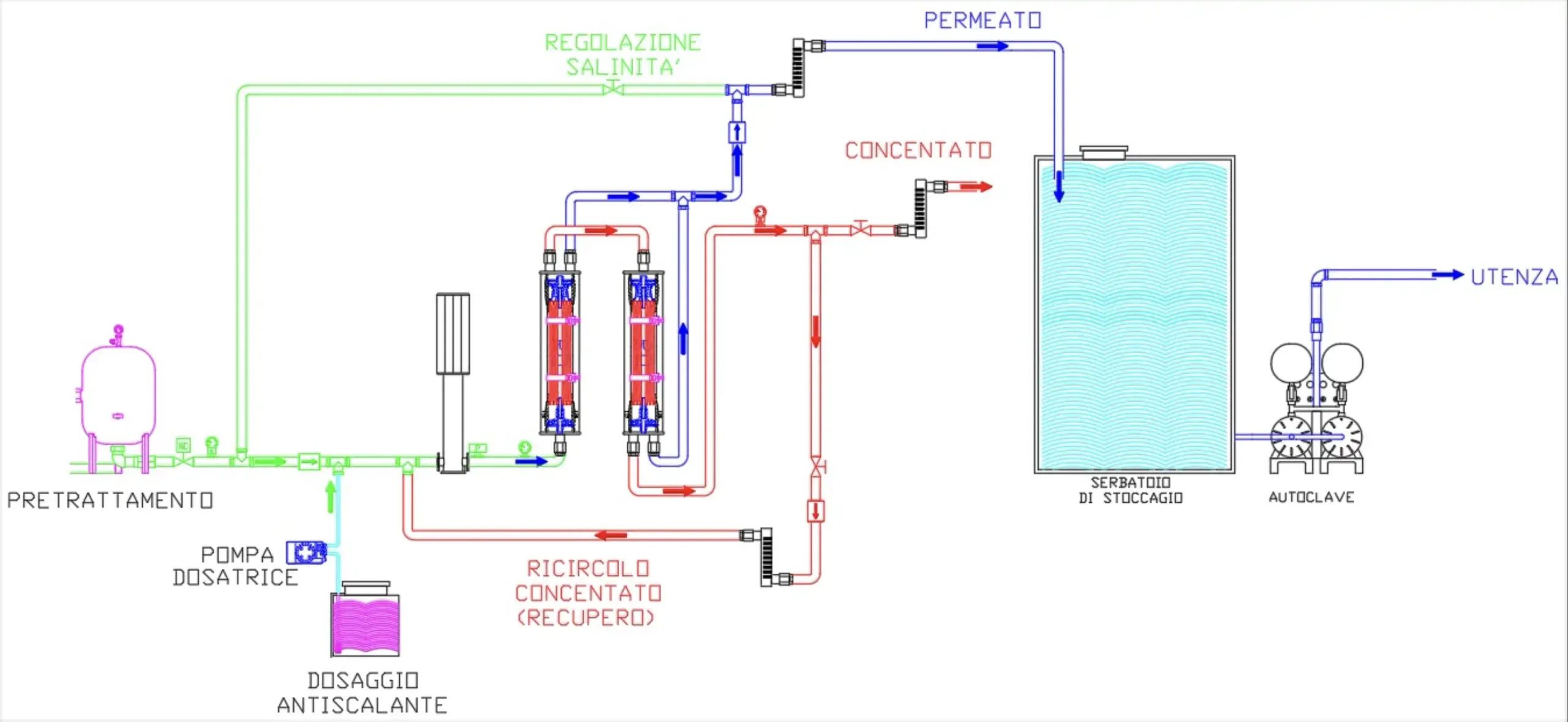
molecular separation 's technology consists of two steps:
- Pre-treatment
- Membrane Technology
Pre-treatment
PRE-TREATMENT includes all the necessary and essential treatments performed prior to the installation at molecular separation.
It is essential for:
- the system's service life
- minimize the use of chemical cleaning agents
- minimize the frequency of membrane replacement.
It therefore has a direct impact on the system's performance.
Membrane Technology
Membrane technology is a general term for a number of distinct separation processes. Membranes are increasingly used to produce treated water from groundwater, surface water, or wastewater. The membrane separation process is based on the use of semipermeable membranes.
The principle is quite simple:
the membrane acts as a highly selective filter that allows water to pass through while retaining suspended solids and other substances.
Membranes function as a selective separation barrier. Some substances can pass through the membrane, while others are retained. This process takes place at low temperatures, allowing for the treatment of heat-sensitive materials.
Low energy consumption: most of the energy required is used to pump liquids through the membrane
Membrane filtration can be divided into:
- Microfiltration – Ultrafiltration
- Removal of Large Particles
- High performance
- Small pressure differences
- Nanofiltration – molecular separation
- It doesn't work according to the pore principle
- Removing Salts from Water
- Large pressure differences
molecular separation s is a process in which water is demineralized by passing under pressure through a semipermeable membrane.
Permeable
The membrane is permeable to certain species (water molecules)
Non-Permeable
The membrane is impermeable to certain substances (dissolved ions and other contaminants)
The principle of theosmosis
A semipermeable membrane is placed between two compartments. To achieve equilibrium (the same concentration of salts on both sides of the membrane, a fundamental law of nature), water will pass from the compartment containing pure water to the one containing salt, in order to dilute the salt solution.